Prima Lux_ The Classic Method
The CLASSIC METHOD is a sparkling wine making technique that involves refermenting the wine in the bottle .
The origins
The classic method owes its origins to France , specifically the Champagne region and to a Benedictine monk who was treasurer and manager of the vineyards of the Abbey of Saint-Pierre d'Hautvillers .
His name has now become illustrious: Pierre Perignon known to all as Dom Perignon .
Legend has it that Dom Perignon, at the end of the 17th century, invented the legendary sparkling wine (called only Champagne later ) . There are different versions of the facts but in any case the abbot discovered the foaming , that is, the process through which carbon dioxide is developed after refermentation in the bottle.
He also deserves credit for selecting the most suitable grape varieties for making Champagne: Pinot Noir, Chardonnay and Pinot Meunier.
The classic method was initially called “ méthode champenoise” and this term was used by all producers in Europe.
But, in the 1990s, following several disputes, the Champagne region managed to obtain the primogeniture and exclusive rights to the term “ methode champenoise ”.
Thus, in Italy the "Metodo Classico" (or Traditional Method) was born to identify on the label products obtained with the refermentation method in the bottle.
Fun fact: the classic method sparkling wines produced in France outside the Champagne region are called “ Crémant ,” a reference to the vanilla notes imparted by the yeasts to the aroma of these wines.
Spoiler: given the French origins of the method, in this article you will have to familiarize yourself with many "made in France" terms 😉
The Step By Step Phases

Let us now look in detail at the stages of sparkling wine production as envisaged by the Classic Method .
1-Production and assembly of base wines
Sparkling wines are vinified like still wines, starting from early grapes that guarantee good acidity. If a cuvée (mix of wines from different vintages) the wine it will not have an indication of the vintage on the label; on the contrary, if the grapes are of a single vintage it will be used on the label the expression MILLESIMATO with the reference year indicated. In addition, if the grapes come from only white grape varieties sparkling wine is defined Blanc de Blancs , on the other hand, if the wine is produced by assembling black grapes vinified in white we will have a Blanc de Noirs .
Our PRIMA LUX is therefore a vintage Blanc de Blancs (we only use Chardonnay grapes).
2-Addition of the ''liqueur de tirage''
A solution composed of: base wine, sugar of cane, yeasts selected and mineral salts. This way you can proceed to fermentation process which will lead to the development of alcohol and of carbon dioxide (the famous bubbles).
3-Bottling with yeasts
The wine to which the has been added liqueur de tirage It is bottled in very thick glass bottles, closed with a crown cap. The bottles must withstand many atmospheres of pressure and must protect the wine from light. In addition, a small plastic cylinder ( bidule ) is inserted under the cap to collect the yeasts exhausted at the end of the fermentation .
4-Second fermentation (prise de mousse)
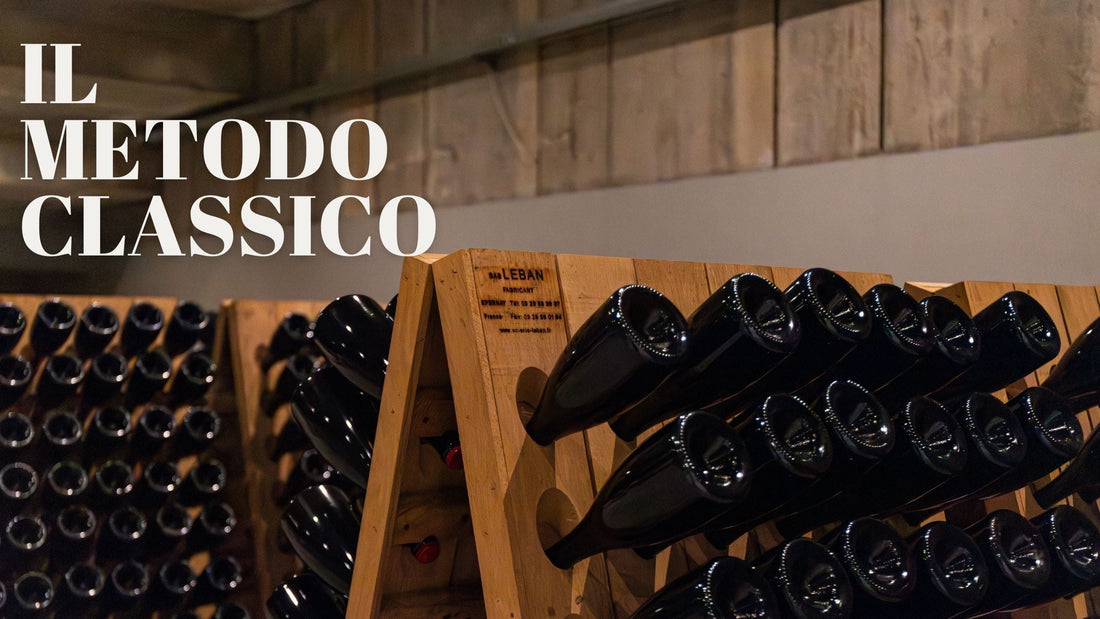
In the bottles, stacked horizontally for a period of more than 18 months in environments with temperatures between 10° and 12°, the sugars are transformed by yeasts , developing alcohol and carbon dioxide. Therefore, once the fermentation , the membranes of the yeasts they begin to decompose and release perfumes and complex aromas. In particular, it should be noted that the long period of refinement (years!) leads to the development of the perlage fine and persistent.
5-Remuage
Once the refinement is complete, the lees of the exhausted yeasts are separated from the sparkling wine. At this point, the bottles are shaken and rotated ( remuage ): the residues thus concentrate at the tip of the neck of the bottle. bottle . We do the riddling manually, as we produce only a few thousand bottles.
(When larger quantities are involved, however, the riddling is carried out mechanically using special machinery capable of rotating baskets containing hundreds of bottles).
6-Disgorgement (or “dégorgement”)
At this stage, the lees are expelled using an exclusively mechanical process. Specifically, the bottle necks are frozen facing downwards, the crown caps are removed, and the lees are collected in bidules.
7-Dosage
The fermentation process involves the transformation of all the sugars : sparkling wine is completely dry. Before final corking, it is necessary to add liquid to compensate for the volume lost during disgorgement. This liquid is called " liqueur d'expedition " and can have varying degrees of "dosage" depending on its sugar content. Remember that if the top-up is done with the same sparkling wine, there is no dosage and the sparkling wine will be perfectly dry.
PRIMA LUX is therefore a "no dosage" .
Also known as ''dosage zero'' or ''pas dosè'' or ''pas operè'' or ''dosage 0'', it represents the maximum expression of purity and authenticity of the Classic Method bubbles!!
8-Corking and packaging (Habillage)
The final stage involves corking with the classic mushroom cork and wire cage, and packaging. Label and capsule, and voilà: the bottle is ready! In reality, it takes a few more months for proper bottle aging before it reaches your table!

Don't call it Prosecco
A necessary clarification: if the classic method is a sparkling wine and Prosecco is a sparkling wine, then it follows that the classic method and Prosecco are the same. No! Nothing could be further from the truth. Not all bubbles are the same.
Prosecco is a sparkling wine obtained from Glera grapes using the Charmat method (or Martinotti method).
This method requires the second fermentation to take place in an autoclave (a large, pressurized steel container at a constant temperature) for a period ranging from 30 days to a maximum of 6 months. It's certainly simpler and quicker than the Classic Method, producing smoother, fruitier wines that are less structured , particularly suited to drinking as an aperitif.
The Classic Method, on the other hand, with the long permanence of the yeasts in the bottle, produces much more evolved sparkling wines and Structured, with a fine and persistent perlage, complex and elegant aromas ranging from floral fragrances to notes of bread crust, yeast, hazelnut, dried flowers, and ripe fruit. The palate is more elegant, deep, and balanced. With a long and complex aromatic persistence, they leave a refined finish with citrus, mineral, and bready aftertaste, making them perfect for accompanying a meal or for toasts and celebratory occasions in the name of quality.
Now all you have to do is discover our Classic Method PRIMA LUX
Cheers!