
ITALY AND WINE: WE'RE BREAKING RECORDS! 🇮🇹 🍇 🍷
Italy is universally recognized as the home of viticultural diversity, boasting the largest number of native grape varieties in the world. This primacy not only contributes to the country's oenological richness but also represents an invaluable cultural and agricultural heritage.
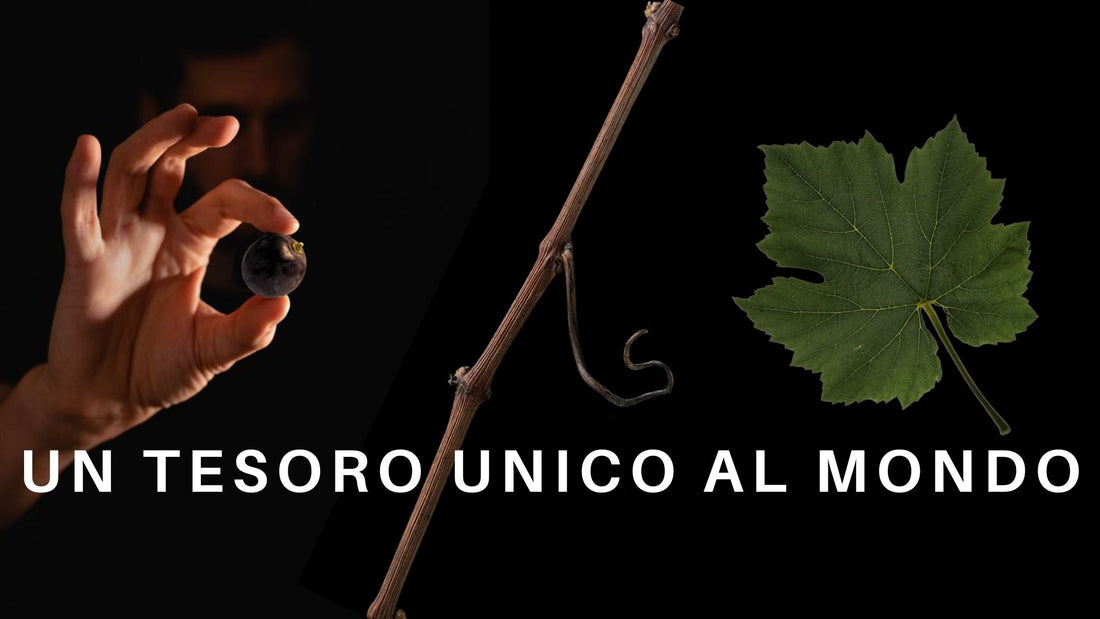
Over 500 native grape varieties bear witness an extraordinary biodiversity. These varieties, the result of a long history of selection and adaptation to different territories, represent true hidden gems of our country, often unknown to most. Behind each vine lie fascinating stories, ancient traditions, and organoleptic peculiarities that deserve to be discovered and appreciated.
NATIVE GRAPE VARIETIEs/ autochthonous vine
 Autochthonous derives from the Greek terms autòs (self) and chtòn (earth or soil).
A native grape variety therefore emphasizes the strong link between the grape and its territory of origin. In other words, a native grape variety is a child of its own land, where it has planted its roots and can express itself at its best thanks to the unique characteristics of the climate, soil, and culture of a circumscribed area.
To be native, it must obviously reside in the same environment for several years and give rise to terroir wines.
In summary, here are the reasons why native grape varieties are so special:
- Authenticity: they are closely linked to their region of origin, so when you taste a wine made from a native grape variety, you are experiencing the essence of that land.
- Vocation: a territory suited to host a specific grape variety will produce wines that will not have the same characteristics and the same result in another region.
- Biodiversity: they contribute to the diversity of the wine world, offering a vast and heterogeneous heritage of unique grape varieties.
- Adaptation: they integrate wonderfully into their natural environment, proving more resistant to diseases and regional climatic conditions.
- Tradition and Identity: cultivated by generations of winemakers, they are an integral part of history and local culture, representing a tradition passed down through time.
- Sustainability: being well adapted to their territory, they require few chemical interventions in the vineyard, making them green friendly.
Therefore, native grape varieties are not just a journey through the flavors and historical traditions of a place, but also contribute to the sustainability and environmental biodiversity of the place itself.
🇮🇹 FIRST IN THE WORLD
With the 2024 harvest, Italy has reclaimed the top spot in the podium for global wine production behind France, Spain, and the United States.
Every year it's a battle for the lead in hectoliters produced with our cousins across the Alps. One year they win, and the next, weather permitting, we win.
But there's another record, another world record, even more important, where our country is unstoppable: almost half of the existing grape varieties in the world today are Italian. Out of a total of over 1300, more than 600 are cultivated within the borders of the Belpaese. (France – which still maintains a great variety of cultivation – counts "only" 210 native grape varieties, just to give an idea!).

In the ranking compiled by the International Organisation of Vine and Wine on the biodiversity of cultivated grape varieties, Italy clearly outperforms its two main competitors. To be clear, while in France and Spain, 10-15 grape varieties cover 75% of national production, in Italy, this percentage is ensured by as many as 80 types of grape varieties. This data highlights Italy's great care and attention to the preservation of small vine varieties.
If we look at the most widespread Italian grape varieties, we find a very balanced situation: Sangiovese, widespread throughout almost all of central Italy, represents 8% of national production; other well-known varieties including Montepulciano, Glera, and Pinot Grigio do not exceed 4%. In France, the most cultivated grape varieties are significantly more present, with Merlot at 15% and Grenache and Ugni Blanc at 10%. In Spain, we find a situation of super-dominant grape varieties: Airen and Tempranillo varieties are at 22% and 21% respectively.
NATIVE GRAPE and beyond

If an autochthonous grape variety is a variety born and grown exclusively in its place of origin, conversely, an allochthonous grape variety is a variety that has traveled by land and sea, finding new homes in different parts of the world. These varieties, compared to their land of origin, have spread easily to other areas or regions, to the point of also being known as "international grape varieties".
The versatility and great adaptability of allochthonous grape varieties make them capable of thriving positively in different contexts and environmental situations. Among the most famous allochthonous grape varieties are Pinot Noir, Sauvignon, Chardonnay, Merlot, Cabernet, and Malbec, which have found success and widespread distribution not only in Europe but also overseas (Australia, California, Chile, South Africa, etc. etc.).
Last curiosity: have you ever wondered which is the most widespread grape variety in the world? Obviously, it cannot be Italian since, as we have seen, we are a country oriented more towards quality production than quantity. It is not even French and it is not a grape variety for wine production but for table grapes. It is called "Kyoho", occupies 365,000 hectares worldwide, and the largest extension is in China.
Cabernet-Sauvignon is the number one wine grape variety on the planet: 340,000 total hectares.
In any case, whether native or allochthonous, the important thing is to drink well! But the next time you taste our native wines Terra (Violone & Sangiovese), Thesan and Thesan 36 (Canaiolo Nero 100%) or Gaia Cecilia (Violone 100%), remember that you are drinking a unique treasure that carries with it the soul of its territory, Tuscia.
Cheers!!